
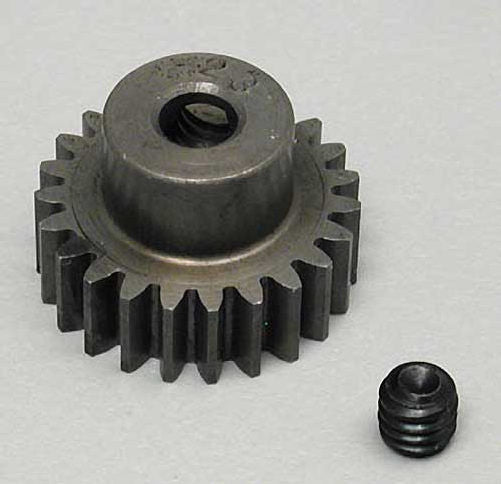
Changing the pinion or spur gear is the cheapest way to change how your RC car drives. One gear swap can add top speed, give you more punch out of corners, or bring down a motor that runs too hot. This guide explains pitch and module, how gear ratio works, how to pick a pinion size, and how to set gear mesh so you don't strip a spur on the first run.

Pinion and spur: what each gear does
The pinion is the small gear on the motor shaft. The spur is the large gear it drives, which turns the transmission or center shaft. The number of teeth on each one sets how many times the motor turns for each turn of the spur.
- Bigger pinion or smaller spur: higher top speed, slower acceleration, more load and heat on the motor and battery.
- Smaller pinion or bigger spur: quicker acceleration, lower top speed, cooler motor.
Most drivers change the pinion and leave the spur alone, because pinions are cheap and quick to swap. Change the spur when you need a bigger jump than the pinion range allows.
Pitch and module: the gears have to match
Pitch (in inches) and module (metric) describe the size of the teeth. A pinion and spur only work together if they have the same pitch or the same module. Mixing them chews up both gears quickly.
- 64 pitch (64P): very fine teeth, used in some 1/10 on-road and 1/12 race cars.
- 48 pitch (48P): the most common size for 1/10 electric buggies, trucks and touring cars.
- 32 pitch (32P): coarser teeth for 1/10 bashers and short course trucks with stronger motors.
- Mod 0.4 to 0.6: small metric gears used in mini and micro vehicles and many touring cars.
- Mod 0.8: common in 1/10 4x4 bashers and crawlers.
- Mod 1.0 and up: 1/8 scale buggies, truggies and monster trucks on high-power brushless systems.
48P and Mod 0.5 look almost the same, and so do 32P and Mod 0.8, but they are not the same size. Check your manual or the old gear before you order. The pitch or module is printed on most gears and in every listing.

Bore size: the pinion has to fit the motor
The hole in the pinion (the bore) must match the motor shaft. 1/10 motors usually have a 3.17mm (1/8") shaft, most 1/8 scale motors use 5mm, and mini motors use 2mm or 2.3mm. A pinion with the wrong bore will not fit, or will wobble and strip.
Gear ratio and final drive ratio
Gear ratio is the spur teeth divided by the pinion teeth. An 81T spur with a 23T pinion gives 81 ÷ 23 = 3.52:1.
Most vehicles have a second, internal ratio in the transmission or diffs. Multiply the two to get the final drive ratio (FDR), which is the number racers compare. If your transmission ratio is 2.6:1, the FDR in the example is 3.52 × 2.6 = 9.15:1. A higher FDR number means more acceleration and less top speed. Your manual lists the internal ratio and usually a gearing chart for different motors.
How to choose a pinion size
- Start with the stock gearing or the manual's chart for your motor and battery.
- Change one or two teeth at a time. Big jumps make it hard to tell what changed and can overheat a motor in one run.
- Gear down for big tires, heavy bodies, hot days, grass and 3S batteries. All of these add load.
- Gear up only if the motor stays cool. Speed is only worth having if the electronics survive it.
Check motor temperature after every gearing change
Run a full battery, then check the motor can temperature right away. As a rule of thumb, most brushless motors are happy under about 160°F (71°C). If the motor or speed control is hotter than that, or the speed control goes into thermal shutdown, drop one or two teeth on the pinion. An infrared temp gun such as the Powerhobby RC2 temperature gun makes this a five-second check.

Setting gear mesh
Mesh is how tightly the pinion and spur teeth fit together. Too tight and the drivetrain binds, heats up and wastes power. Too loose and the teeth skip, which strips the spur.
- Loosen the motor mount screws so the motor can slide.
- Put a strip of plain paper between the pinion and spur.
- Push the gears together on the paper and tighten the motor screws.
- Roll the gears to remove the paper. You should feel a tiny bit of play when you rock the spur back and forth.
- Turn the spur a full rotation and check for tight spots, since some spurs are not perfectly round.
Also tighten the pinion set screw on the flat of the motor shaft, with a drop of blue thread-lock. A loose set screw is one of the most common reasons a pinion "strips."
Steel, aluminum or plastic gears?
- Hardened steel pinions last the longest and are the right choice for brushless bashers. Robinson Racing pinions like the 18T 32P, 17T Mod 0.8 and 13T Mod 1.0 for 1/8 scale are hardened steel.
- Aluminum pinions are lighter and popular for racing, but they wear faster.
- Plastic and composite spurs are normal on 1/10 vehicles. They are quiet, light, and cheap to replace. Spurs like the Kimbrough 81T 48P or Team Associated Octalock 78T 48P come in many tooth counts.
Keep a few pinions sorted in a case like the RPM pinion gear storage case so you can change gearing at the track.
Shop Robinson Racing pinions, motors and ESCs, and RC tools. To find gears for a specific vehicle, use the Parts Finder.
Frequently asked questions
Will a bigger pinion make my RC car faster?
Yes, a bigger pinion raises top speed, but it also adds heat and slows acceleration. Go up one or two teeth and check motor temperature after a full battery.
Can I use a 48 pitch pinion with a Mod 0.5 spur?
No. They are close in size but not the same, and mixing them wears out both gears fast. Always match pitch to pitch or module to module.
Why does my spur gear keep stripping?
The usual causes are a mesh that is too loose, a loose pinion set screw, a motor mount that slips, or a rock caught in the gears. Reset the mesh with the paper method and thread-lock the set screw.
Should I gear down when I switch from 2S to 3S?
Usually, yes. 3S spins the motor faster, so most vehicles need a smaller pinion to keep motor temperatures safe. Check your manual for its 3S gearing.
Not sure which gears fit your vehicle? Call us at 202-888-3669, or find more how-tos on our RC Guides page.