
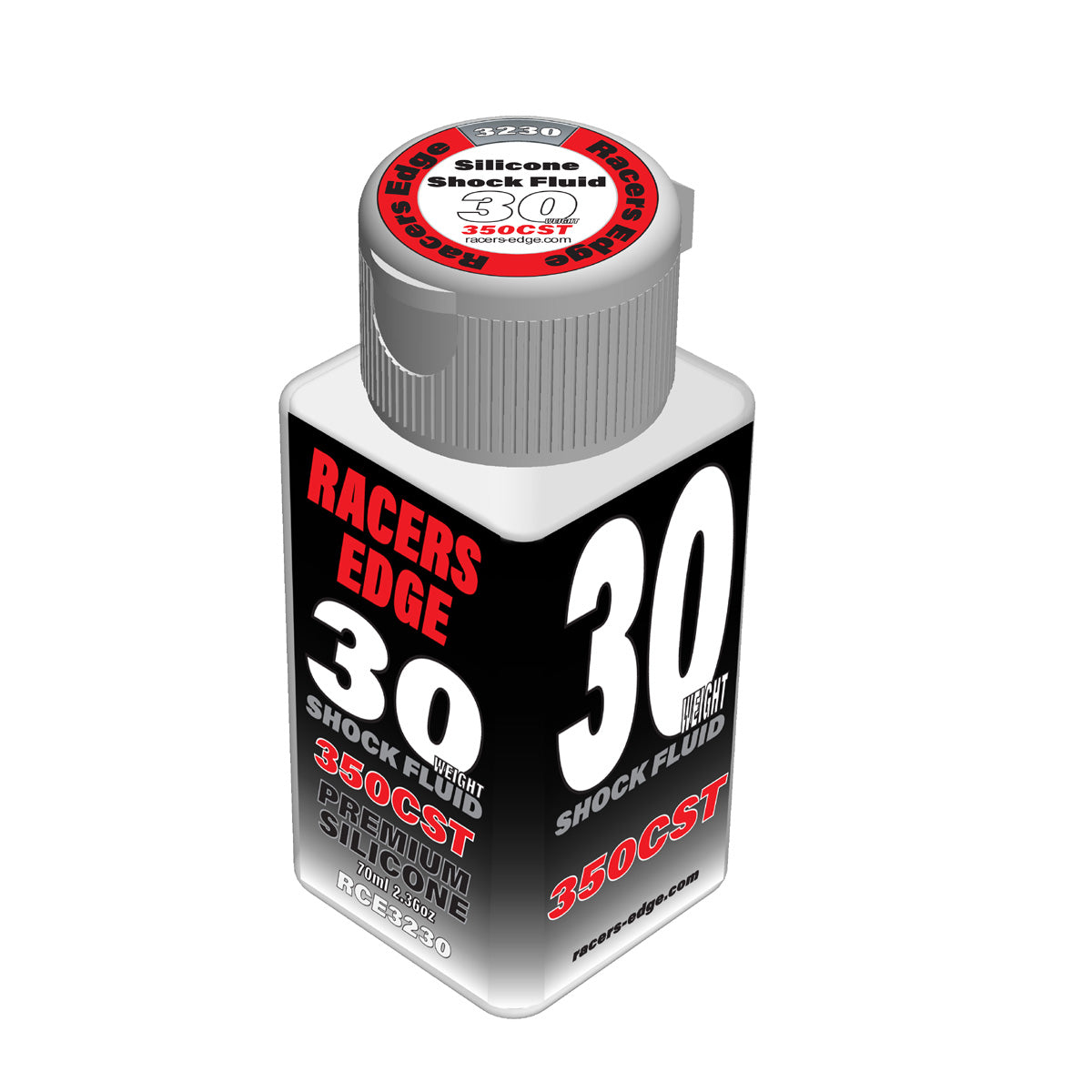
Shock oil and diff fluid are the cheapest tuning parts in RC, and two of the most effective. The right oil makes a truck land jumps flat instead of bouncing, and the right diff fluid puts power down instead of spinning one tire. This guide explains what the numbers mean, how thick oil changes handling, where to start, and how to refill shocks and diffs.

Weight vs cSt: read the right number
Shock oil is sold by weight (wt) and by cSt (centistokes), a standard measure of viscosity. Brands don't always agree on weight, so one company's 30wt can be thicker or thinner than another's. cSt is the same everywhere, so compare oils by cSt when you switch brands.
A few common pairings from Racers Edge silicone shock oil:
Always use 100% silicone oil in RC shocks and diffs. It keeps its thickness better across temperatures and won't damage the seals.
What thicker or thinner shock oil does
The oil controls how fast the shock moves, not how much it holds the car up (that's the springs' job).
- Thicker oil: slower suspension, less bounce, more stable over big jumps and in fast sweepers. Too thick and the car skips over bumps instead of soaking them up.
- Thinner oil: faster suspension, more grip on bumpy and loose surfaces, more body roll. Too thin and the car bottoms out and bounces after landings.
Temperature matters too. Oil thins out as it warms up, so many racers go up a step on hot days and down a step in the cold.
Where to start
Your kit's manual or setup sheet is the best starting point, because shock piston size changes everything. A shock with smaller piston holes feels like thicker oil. As a rough guide:
- 1/10 2WD and 4WD buggies and stadium trucks: around 25wt to 40wt (275 to 500 cSt).
- 1/10 short course and bashers: around 30wt to 50wt, a little thicker for big jumps.
- 1/8 buggies and truggies: around 450 to 650 cSt.
- Rock crawlers: often thin to medium oil, 20wt to 35wt, so the suspension can droop and follow the rocks.
Change one end at a time, in steps of about 5wt, so you can feel what each change did.
Diff fluid: how it works
A gear differential lets the left and right wheels turn at different speeds through a corner. The fluid inside sets how easily they do that.
- Thinner diff fluid: the diff unloads more easily, which helps the car turn, but more power goes to the wheel with less grip.
- Thicker diff fluid: the diff acts closer to a locked axle, giving more forward drive and stability but less steering.
Diff fluid is much thicker than shock oil, so it is measured in thousands of cSt. Racers Edge, Team Associated and 1UP Racing sell it in many weights, from 2,000 cSt and 4,000 cSt up through 10,000 cSt, 30,000 cSt and 100,000 cSt.

Diff fluid starting points
- 1/8 4WD buggy (front, center, rear): a common baseline is about 7,000 / 7,000 / 3,000 cSt. Thicken the center for more forward drive on high-grip tracks.
- 1/10 4WD: often a few thousand cSt front and rear, with thicker fluid in the front for on-power steering stability.
- 4x4 bashers and monster trucks: thicker center diff fluid (or very heavy fluid like 200,000 cSt) stops one end from spinning up in the air.
- Touring cars: follow the setup sheet; many run a spool or a one-way up front and fluid in the rear.
Ball diffs and gear diff grease
Not every diff takes fluid. Ball differentials on many 2WD race cars use a special grease, like Racers Edge ball diff grease. Some gear diffs use a thick grease instead of fluid, like Kyosho #15000 diff gear grease or Racers Edge gear diff grease. Your manual will say which one your diff needs.
How to refill and bleed shocks
- Take the shock off the car and remove the cap and spring. Empty the old oil and clean the body.
- Check the O-rings. A light coat of 1UP Racing Blue O-Ring Grease keeps them sealing smoothly.
- With the shaft all the way down, fill the body almost to the top.
- Move the shaft up and down slowly to work out air bubbles, then let it sit for a few minutes so the bubbles rise.
- Top off, then install the cap (or bladder) slowly, letting excess oil bleed out.
- Push the shaft in. It should rebound the same amount on all shocks in a pair. If one feels different, refill it.
Rebuild shocks when they feel bouncy, leak, or squeak, and after every couple of months of hard use.
How to refill a gear diff
- Open the diff case and clean out the old fluid.
- Fill until the fluid just covers the cross pins and small gears.
- Turn the gears slowly to release air, wait a few minutes, then top off.
- Close the case with even screw pressure and check for leaks around the gasket.
Shop oils, glues and cleaners, or browse hop-up parts like aluminum shocks for your vehicle with the Parts Finder.
Frequently asked questions
What weight shock oil should I use?
Start with what your manual lists. If it doesn't list one, 30wt to 35wt is a sensible starting point for most 1/10 off-road cars. Go thicker if the car bounces and bottoms out, thinner if it skips across bumps.
Is 30wt from one brand the same as 30wt from another?
Not always. Compare the cSt numbers instead, which are standard across brands.
Can I use shock oil in my diff?
Only if your manual calls for that thickness. Most gear diffs need far thicker fluid than any shock oil.
How often should I change diff fluid?
Racers often refresh it every few race days. For bashing, check it a few times a season, or any time the diff starts to feel loose or leaks.
Have a question about your setup? Call us at 202-888-3669, or find more how-tos on our RC Guides page.